
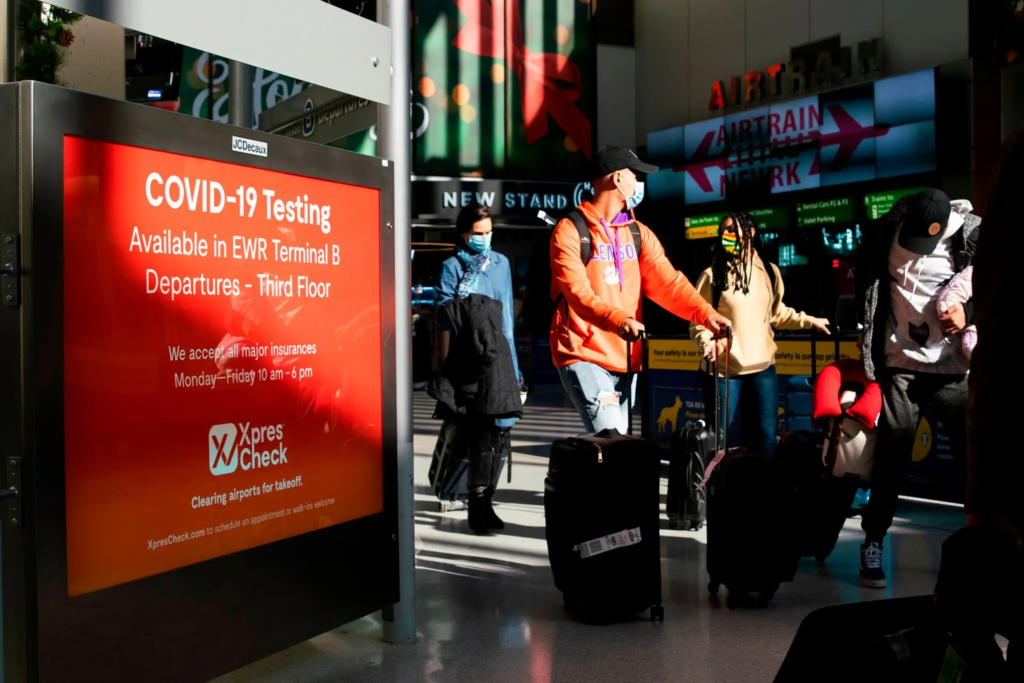
Photo taken at Newark International Airport on Nov 21, 2020,
capturing people traveling for Thanksgiving.
Image Source: CNN (2020). https://edition.cnn.com/2020/11/26/health/us-coronavirus-thursday
Introduction
In early 2020, the global tourism industry evaporated. As borders closed and planes were grounded, the flow of international capital ceased almost overnight, creating an unprecedented natural experiment in political economy. This project explores how divergent national health policies, specifically the United States’ decentralized reopening versus China’s centralized “Zero-COVID” strategy, dictated the timing and structural recovery of their respective tourism economies between 2020 and 2023. We argue that while the United States experienced a volatile but rapid return to pre-pandemic financial levels, China’s tourism sector remained stagnant for significantly longer, driven by policy choices that prioritized containment over connectivity. To demonstrate this, we synthesized data from four primary sources: the UNWTO Tourism Statistics Database to compare global arrival and expenditure trends, the U.S. Travel & Tourism Satellite Account (TTSA) from the Bureau of Economic Analysis for a granular look at U.S. sector recovery, the Oxford COVID-19 Government Response Tracker (OxCGRT) to quantify policy stringency, and Google’s COVID-19 Open Data Repository to correlate infection rates with economic mobility. By layering epidemiological timelines over financial indicators, this dataset reveals the precise economic cost of health security
Place in Literature
Current literature on the pandemic’s impact on tourism is largely divided into two distinct camps: epidemiological assessments of policy efficacy and macroeconomic reports on financial loss. Early studies, such as those by Lagos et al. (2021) and Kolahchi (2021), establish the mechanisms of the initial collapse, focusing on the immediate shock to supply chains and labor. Later empirical work, such as Agyapon-Ntra and McSharry (2023), evaluates the success of government interventions like lockdowns in curbing mortality but often stops short of analyzing the long-tail economic recovery. A significant contradiction exists in the literature regarding the “trade-off” between health and economy, while some scholars argue that strict health measures build consumer confidence and aid recovery, others suggest that prolonged restrictions permanently alter travel behavior. Furthermore, existing literature often treats the pandemic as a singular global event rather than a divergent timeline. What remains largely unexplored, and what our project addresses, is a direct, data-driven comparison of how the duration of policy stringency (specifically the difference between the U.S. reopening in 2021 and China’s in 2023) correlated with the rate of value-added recovery in the tourism sector.
Significance
This project is critical because it moves beyond the simple narrative that “COVID-19 hurt tourism” to analyze how political choices shaped economic resilience. We are examining the correlation between OxCGRT stringency indices and UNWTO expenditure data because we want to find out if stricter health policies yielded a “confidence dividend” or merely delayed economic collapse, so that we can help others understand the tangible trade-offs governments face during global health crises. This work connects to larger questions about the fragility of globalization and the reliance of modern economies on cross-border mobility. Ultimately, our analysis seeks to illuminate the “price” of safety, demonstrating that the U.S.’s rapid financial recovery came at the cost of public health volatility, while China’s stability came at the cost of isolation. Understanding these distinct recovery trajectories is essential for policymakers and industry leaders preparing for future disruptions, proving that in a pandemic, biology is inevitable, but the economic outcome is a policy choice.
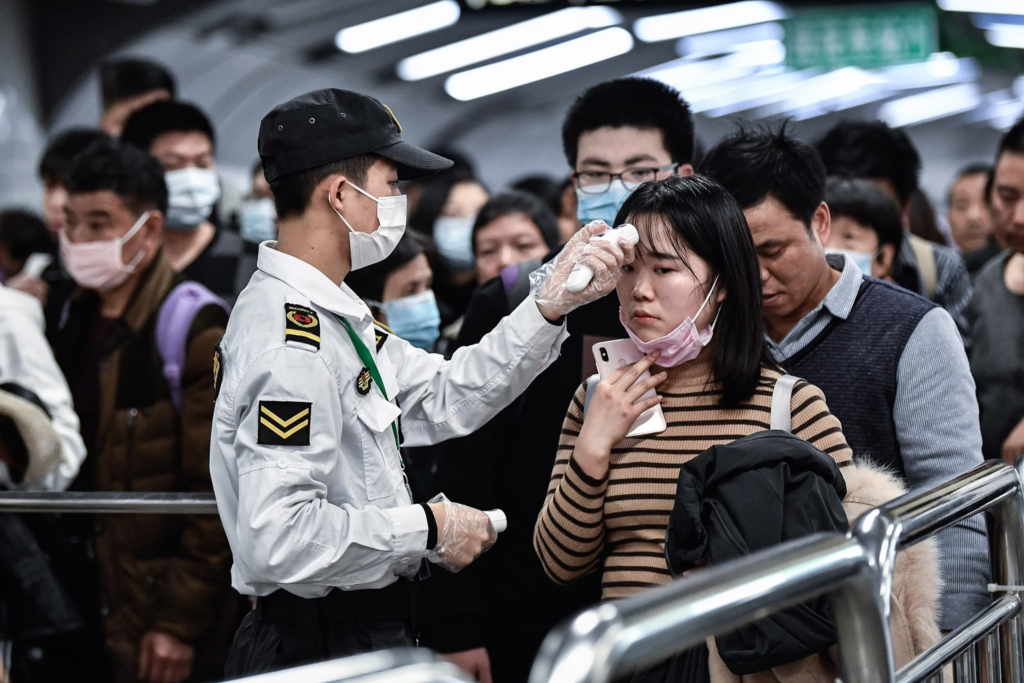
Citizens in Guangzhou, China, wear masks as they are screened for COVID-19.
Image Source: National Geographic (2020). https://www.nationalgeographic.com/travel/article/how-chinese-virus-outbreak-impacts-travel
A Timeline of Key Events
Map Illustration of COVID-19 in a State Level